4 Open-Source AI Projects: GLM, exo, VideoPipe, Personal_AI_Infrastructure
01 Zhipu Open-Sources GLM-4.7
GLM-4.7, developed by Zhipu AI, has been officially released with an announcement of its upcoming open-source release.
It has secured the top spot in China and among open-source models across multiple authoritative benchmarks, including LiveCodeBench and Code Arena.
Its comprehensive coding capabilities are now on par with, and even surpass those of Claude 4.5 Sonnet in certain aspects.
Furthermore, Zhipu AI recently filed its prospectus with the Hong Kong Stock Exchange, vying to become the world’s first publicly traded company focused on large language models. Domestic large models have now gained the practical strength to compete at the global top tier in the core domain of programming.
What’s more, some developers have even recreated the game Plants vs. Zombies using GLM-4.7.
02 Turn Idle Phones into an AI Cluster
This distributed AI inference open-source framework, boasting 36,000 stars on GitHub, is truly impressive.
It enables you to build a private AI cluster using your existing devices—such as iPhones, iPads, Macs, Android devices, and even Raspberry Pi boards.
It breaks the constraint that running large models requires high-end GPUs, achieving large model deployment through resource pooling.
The framework features strong hardware adaptability: it can dynamically shard models based on network topology and the remaining computing power of each device.
By supporting technologies like RDMA over Thunderbolt, exo significantly reduces communication latency between devices, making distributed inference far more efficient than that over regular network connections.
03 AI-Powered Video Analysis Platform
VideoPipe is a cross-platform framework for video structuring and analysis, written in C++.
Its design philosophy resembles an assembly line: it splits video processing stages—such as decoding, inference, rendering, and encoding—into independent nodes. Users can flexibly combine these nodes according to business needs to build complex visual analysis systems.
A key feature of this framework is its lightweight architecture and minimal dependencies, making it ideal for rapid deployment in real-world engineering scenarios, including security surveillance, traffic management, and face recognition.
For example, it can perform real-time analysis of vehicle trajectories, automatically identifying violations such as illegal U-turns, line crossings, or retrograde driving. It not only detects vehicles but also recognizes license plate numbers, and records violation processes as short video clips for evidence collection.
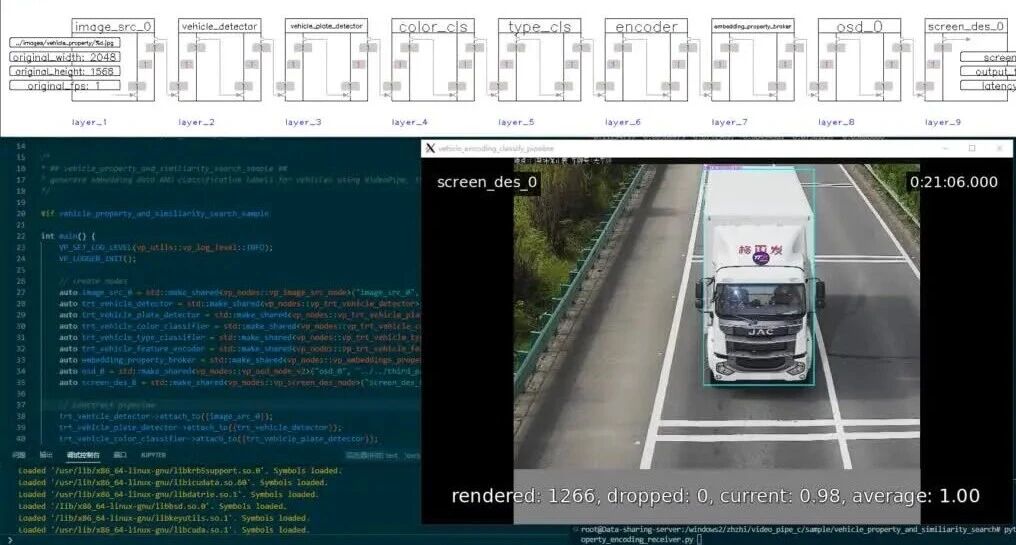
It supports mainstream video streaming protocols like RTSP and RTMP, as well as local file input. It also integrates OpenCV and GStreamer to enable hardware-accelerated decoding.
The project provides detailed Chinese documentation and sample code, greatly lowering the barrier to C++-based video analysis development.
04 Personal AI Infrastructure
This open-source project is called Personal_AI_Infrastructure.

As the name suggests, this project aims to help you build a dedicated AI infrastructure for personal use.
Its vision is to empower individuals to own and control their own AI operating systems, instead of relying on black-box services provided by large corporations.
The project features a well-structured architecture, consisting of four core modules: Skills, Agents, Hooks, and History.
Currently built on Anthropic’s Claude Code, its core logic centers on AI-augmented humans: it captures users’ work patterns through automated workflows and solidifies them into reusable AI skills.
Additionally, it integrates Fabric, another well-known open-source project, leveraging a vast library of curated prompts to handle daily tasks such as document summarization, code writing, and security analysis.
URL: https://github.com/danielmiessler/Personal_AI_Infrastructure